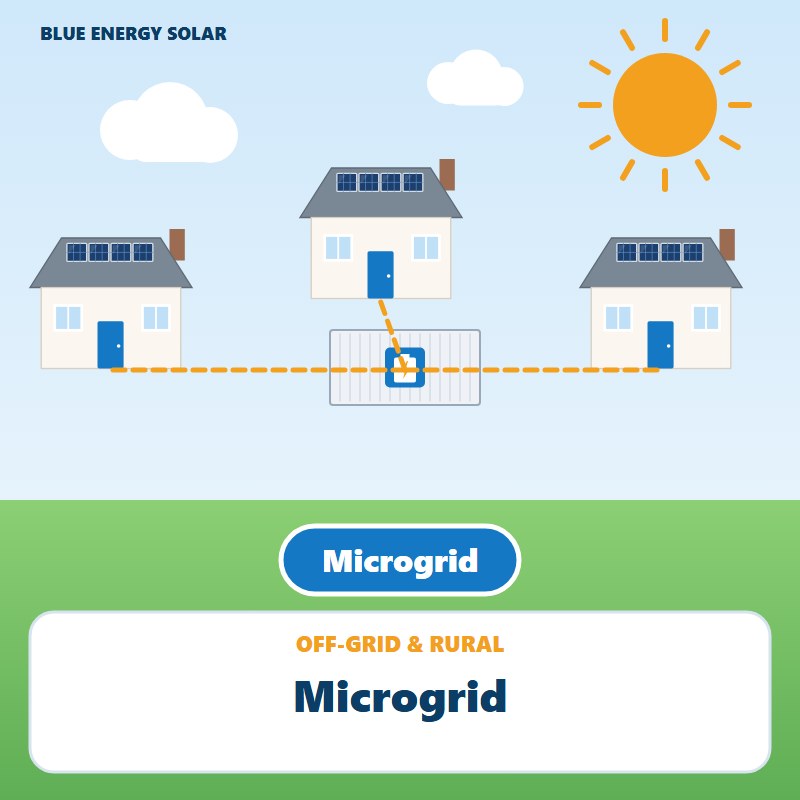
A designed microgrid linking several buildings to shared solar, batteries and generators, with a control system that keeps farms, camps and small communities powered.
From $79,000 (Per project), including GST. Indicative starting price: the final fixed price is confirmed in writing after a site assessment.
SKU: BES-RUR-05
Brand: Blue Energy Solar
Pack size: Per project
Form: Design + supply + installation
Categories: Commercial & Rural
Share it:
A microgrid is a small, local electricity network. It connects several buildings to shared generation and storage, usually solar arrays, battery banks and one or more generators, and uses a control system to decide what runs, what charges and when the generator starts. A microgrid can operate fully off-grid or alongside an existing grid connection.
Microgrid projects start from $79,000. This is an indicative starting price; the final price depends on the number of buildings, total and peak demand, days of autonomy, cable distances, generator arrangements, control requirements and approvals.
What's included
A site survey and load study of each building, including seasonal and peak demand
Microgrid design covering generation, storage, distribution cabling and protection
JA Solar arrays with battery and inverter systems from Sigenergy, GoodWe, Fox ESS or Sungrow, selected to suit the design
Generator integration with automatic start and load control, where the generator supports it
Energy management and remote monitoring of the whole site
Installation by SAA-accredited installers, with electrical work by our licensed electricians
Commissioning, operating documentation and training for site staff
Why Blue Energy Solar
A microgrid succeeds or fails on design detail: protection, cable sizing, generator control and realistic sizing for the worst weeks of the year. We approach every project as an engineering job, starting with measured or carefully estimated loads rather than assumptions, and we explain the trade-offs between battery capacity, generator run time and cost in plain terms.
Recommended for
Farms, camps, retreats and small communities with several buildings that need shared, reliable power away from or alongside the grid.
Sharing generation across buildings often needs less total equipment than separate systems, because demand rarely peaks everywhere at once. The trade-off is more engineering: underground or overhead cabling, protection coordination and clear rules for who uses what.
A diesel generator used as a primary power source commonly costs $1,500-$4,000+ a year in fuel alone; solar and batteries can reduce generator run time considerably.
Where the microgrid serves a business, NSW business battery incentives from 1 September 2026 may apply to eligible batteries from 20 kWh.
Supplying power to separate occupants can raise regulatory questions, which we flag early in the design.
Incentive values change over time, so confirm them on the official government pages before signing.
Directions
1. Request a consultation and share a site map, building uses and any existing generators or solar.
2. We survey the site, measure or estimate loads and review approvals.
3. We present a written design and quote with performance, generator use and staging options.
4. Once accepted, we order equipment and install generation, storage, cabling and controls.
5. We commission the microgrid, train site staff and set up remote monitoring.
Warnings
The price shown is an indicative starting price; the final fixed price is confirmed in writing after a site survey, design and quote.
Projects may need council approval, and grid-connected microgrids need network approval.
Trenching, civil works and generator supply are included only where listed in the quote.
Incentive eligibility depends on the project and is confirmed in writing before you commit.
Design and installation are by SAA-accredited installers, with electrical work by our licensed electricians.
Frequently Asked Questions
A microgrid usually makes sense when buildings are reasonably close together, their loads peak at different times, and one well-maintained battery bank and generator can serve everyone. Separate systems can be better when buildings are far apart, because long cable runs add cost and losses. We compare both approaches during design and show the cost and reliability trade-offs.
Yes. A project can start with a core of solar, batteries and a generator serving the main buildings, with cabling and capacity planned so more buildings or storage can be added later. Designing for the final layout from the start avoids replacing undersized cables or switchgear. We show a staged plan in the quote if that suits your budget.
Good microgrid design avoids single points of failure where it matters. The generator can carry essential loads if an inverter or battery goes offline, and remote monitoring flags faults early. We document how the system behaves in different failure situations, so site staff know what to expect and what to check before requesting support.
Often, if they are in good condition and compatible with the control system. Generators need suitable automatic start and control connections, and older solar inverters must be able to work safely with the microgrid's battery inverters. We assess existing equipment on site and tell you what can be integrated, what needs modification and what would cost more to keep than to replace.
Delivery Options
Service area & scheduling
Where we work
Sydney and a radius of roughly 200 km: Newcastle, the Central Coast, Wollongong, the Southern Highlands, the Blue Mountains, Bathurst, Orange, Lithgow, Goulburn and the Canberra region.
Timing
Most projects take 2-4 months from accepted design to commissioning, depending on scale, approvals and site access.
How your request works
Send your request and our team contacts you to arrange the site assessment. You receive a written fixed-price quote before any work starts.
All electrical work is carried out by licensed electricians; solar and battery design and installation by SAA-accredited installers.
Blue Energy Solar is a New Energy Tech Approved Seller and holds $20 million public liability cover.